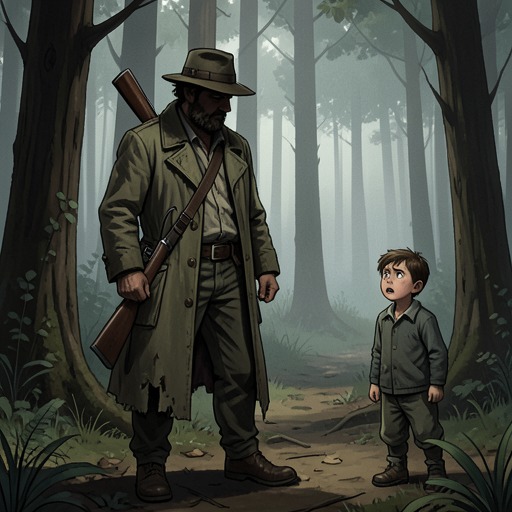
German Army
The Painted BirdThe German Army is presented in The Painted Bird less through its internal organization than through the pressure it exerts on occupied communities: troops demand food, search homes and countryside, guard military installations, and pursue people suspected of resisting or sheltering those marked for persecution. Its presence reaches from village cellars and fields to guarded railways and bridges. In the novel, this military power is part of a wider machinery of occupation and racial persecution, though the narrative does not treat every crime of that system as an act specifically carried out by the Army.
Occupation and the burden on villages
The eastern villages through which The boy passes are already poor and isolated, and occupation makes their insecurity more acute. Peasants must surrender a substantial part of their meager harvest to regular troops as well as to Partisans. Refusal can bring punitive raids that leave settlements in ruins. These competing demands turn food into a matter of survival and make ordinary households answerable to armed groups whose requirements they cannot safely ignore.
German soldiers also search homes for food. At one house, while troops look through the rooms and pursue livestock, The boy is hidden in a cellar. The farmer brings him out only after the army trucks have gone, and he resumes his usual work. The hiding place offers temporary protection, not security: the child’s dark appearance makes him vulnerable to suspicion, while the farmer’s decision to shelter him could expose the household to danger.
The same danger governs a later escape. When a farmer learns of an impending raid after the Germans discover that a Jewish man is being hidden in the region, he orders The boy to flee into the forest at night. By dawn, German soldiers have surrounded the field where the child has taken cover and are walking through the grain. The passage leaves the immediate outcome unstated, but makes clear how quickly an informer’s news can turn a hiding place into a trap.
Searches, transport, and military presence
The Army’s reach is visible not only in village raids but also in the guarded railway. On the line through the forest, ordinary freight trains carry machine guns, with helmeted soldiers scanning the woods and sky. Later, locked cattle cars carry Jews and Roma toward death. The narrative reports that as many as two hundred people are crowded into a car, and recounts what villagers have heard about the stripping of possessions, the sorting of prisoners, and the killing facilities at the destination. This account presents the railway as part of organized persecution, while not identifying every component of the camp system as an Army unit.
The villagers’ response to the trains compounds the scene’s moral unease. They wave to the locomotive crews and guards; people inside the cars, visible briefly through small windows, answer with signals. The exchange is a painful failure of communication: the people outside mistake proximity to the train for an occasion to greet, while those being transported may read the gestures as a greeting meant for them. The trains pass, but their effects remain along the tracks, where the novel describes people searching for those who have fallen or escaped and traces of the dead left behind.
Elsewhere, a high railway bridge is guarded by guns installed in concrete pillboxes. At night, when aircraft pass overhead, the bridge is blacked out; by morning soldiers again man the guns, and a swastika flag flies above it. This fixed defensive position contrasts with the mobile patrols and searches in the countryside. Together, the scenes make military occupation both a daily intrusion into village life and a strategic presence over roads, railways, and infrastructure.
Repression and the occupied order
German troops use searches and exemplary violence to enforce their authority. When they question villagers about Partisan visits, they shoot one or two peasants as a warning. The blacksmith responds by hiding The boy in a potato cellar and promising commanders timely food deliveries and extra grain. This episode shows how protection is negotiated under duress: the blacksmith tries to preserve the child and appease the soldiers at once, but the terms are set by armed occupiers.
The danger is sharpened by the rules surrounding Jews and Roma. The boy is taken for one of these groups because of his dark hair, eyes, and skin; the narrative explains that harboring either could expose a person or community to harsh German punishment. His appearance therefore makes him vulnerable even when no one knows his actual family history. The threat of military enforcement turns a child’s identity as perceived by others into a risk for anyone who offers shelter.
The Army in the wider war and in historical memory
The novel also places German military power within a larger wartime apparatus without collapsing different institutions into one. In its retrospective discussion, the author cites a survivor’s account of German troops arriving with Kalmyk cavalrymen to punish a village accused of sheltering an enemy of the Reich. He also refers to camp commanders’ statements and prisoner records concerning the murder of children and the deaths of Roma prisoners. These materials support his response to critics who had called the novel’s cruelty excessive; they are presented as historical testimony and documents, not as proof that every crime cited was committed by the German Army itself.
The distinction matters because the book’s fictional scenes and its documentary references work at different levels. In the narrative, soldiers search, guard, requisition, and pursue; in the author’s account of the sources, the scope of wartime persecution extends into the camp system and the murder of civilians. The Army is one visible instrument of occupation, while the evidence cited in the afterword situates its actions within a broader regime of violence.
By the autumn of 1944, the regiment sheltering The boy listens to reports of repeated German Army defeats far to the west, and soldiers begin to believe the war may end before they see combat. This later perspective reverses the earlier balance of power: the forces that once searched fields and controlled bridges are now being driven back. Yet military defeat does not immediately resolve the child’s displacement. As the war ends, regulations require lost children to be sent to special centers until their parents’ survival can be determined. The Army’s retreat marks a change in the political landscape, but not an instant return to safety or family.